"Рисунок наглядно представит мне то, что в книге изложено на целых десяти страницах"
Иван Тургенев,"Отцы и дети"
Showing posts with label Harper’s New Monthly Magazine. Show all posts

March 20, 2025

Пруэтт Картер (Pruett Alexander Carter) | 1919 - 1929


The Guest of Honor by Leslie Gordon Barnard. Ladies' Home Journal, Jul. 1927


Пруэтт [Пруетт] Картер (анг. Pruett Alexander Carter; 1891-1955) — американский живописец, иллюстратор, преподаватель; учился в Лиге студентов-художников Лос-Анджелеса, затем в Нью-Йорке; преподавал в Центральной школе искусств в Нью-Йорке (Grand Central School of Art), в Центральной школе искусств и Художественном институте Чуинарда (Grand Central School of Art and the Chouinard Art Institute); иллюстрировал популярные периодические издания, был арт-директором журналов "Этлантэ джёрнл" (Atlanta Journal) и "Гуд хаузкипинг" (Good Housekeeping).


The Gulf by Bradford Gilchrist. Harper's New Monthly Magazine Volume 139, June to November 1919


The Small Frog by Harrison Rhodes. Harper's New Monthly Magazine Volume 140, December 1919 to May 1920


Tropic Frogs by Blair Niles. Harper's New Monthly Magazine Volume 140, December 1919 to May 1920


The Verse on the Window by James Boyd. Ladies' Home Journal, Aug. 1922


The Phantom Husband by Frank R. Adams. Harper's Bazaar, Jan. 1923


The Unearthly by Robert Hichens. Ladies' Home Journal, Jan. 1926


The Cricket by Elsie Singmaster. Ladies' Home Journal, Sep. 1926


The Stars And Bars by Claudia Cranston. Good Housekeeping, Aug. 1928


The First Beau by Bernice Brown. Ladies' Home Journal, Nov. 1929


Pruett Alexander Carter (1891-1955) was an American painter, illustrator, and teacher. He studied at the Art Students League of Los Angeles and then in New York City; taught at the Grand Central School of Art in New York City, the Grand Central School of Art, and the Chouinard Art Institute; illustrated popular periodicals; and served as art director for the Atlanta Journal and Good Housekeeping magazines.


February 10, 2023

Сигизмунд Ивановский (Zygmunt Iwanowski) |1905-1913 | Харперз нью мансли магэзин (Harper’s New Monthly Magazine)


A Music-school Settlement by Philip Verrill Mighels. Harper's New Monthly Magazine Volume 111, June to November 1905

Сигизмунд (Зигмунд) Ивановский (польск. Zygmunt Iwanowski; англ. Sigismund de Ivanowski; 1875-1944) — американский живописец, иллюстратор, портретист; родился в Одессе в польской аристократической семье; в 1896 году окончил с золотой медалью Академию художеств в Санкт-Петербурге, совершенствовал своё мастерство в Варшаве, Мюнхене, Париже и Лондоне. В Лондоне Ивановский женился на Хелен Мозер (Helen Moser), начинающей американской певице; в 1903 году они переехали в Соединенные Штаты. В Америке Сигизмунд Ивановский писал портреты, иллюстрировал популярные периодические издания, в том числе "Харперз нью мансли магэзин". Художник часто смотрел на мир сквозь призму символизма, давая тем самым возможность зрителю почувствовать трансцендентное начало в эмпирических образах.
A Music-school Settlement by Philip Verrill Mighels. Harper's New Monthly Magazine Volume 111, June to November 1905

The Lie by Madge C. Jenison. Harper's New Monthly Magazine Volume 118, December 1908 to May 1909

One Man's Story by Leo Crane. Harper's New Monthly Magazine Volume 118, December 1908 to May 1909

Woman with Yellow Gloves by Madge C. Jenison. Harper's New Monthly Magazine Volume 126, December 1912 to May 1913

The Bodice by Mrs. Henry Dudeney. Harper's New Monthly Magazine Volume 126, December 1912 to May 1913


Zygmunt Iwanowski (Sigismund de Ivanowski; 1875-1944) was born in Odessa into a Polish aristocratic family. He graduated from the Academy of Fine Arts in St. Petersburg. After that, Iwanowski was refining his skills in Warsaw, Munich, Paris, and London, where he married Helen Moser, an aspiring American singer. In 1903 they moved to the United States. Zygmunt Iwanowski soon became recognized as an outstanding illustrator for some popular periodicals. He signed his works as Sigismund de Ivanowski, and under that name he has a place in the history of American painting. The artist often looked at the world through the prism of symbolism, thus giving the viewer the ability to see the transcendent principle in empirical images.
Symbolism is a movement that was born in France in the mid-1880s. "The belief in the dual physical and psychological nature of the universe awakened the desire to overcome the material barrier and to penetrate the sphere of spirituality. It gave an impulse to search for what is completely incomprehensible and unattainable but intuitively perceptible." - Irena Kossowska, Institute of Art of the Polish. Dec 2016, Culture.pl
Символизм (фр. symbolisme) — течение в искусстве, зародившееся во Франции в середине 1880-ых. "Убежденность в двойственной, физической и психической природе вселенной породила стремление преодолеть материальный барьер и проникнуть в сферу духовного в поисках непостижимого и недостижимого, но интуитивно ощущаемого". (Ирена Коссовская, Институт искусства Польской академии наук. Декабрь 2006, Culture.pl)
"Символ — (от древнегреч. σύμβολον - знак, примета) - многозначный иносказательный образ, основанный на подобии, сходстве или общности предметов и явлений жизни... Символический образ может возникнуть как результат использования самых разнообразных образных средств: метафор, образных параллелизмов, сравнений. В отличие от аллегории, символический образ не имеет прямолинейного, рассудочного значения. Он всегда сохраняет живые, эмоциональные ассоциации с широким кругом явлений" [Символизм в литературе, Портал "Символизм древних культур"].


March 6, 2021

Чарлз Эдвард Чамберс (Charles Edward Chambers) |1916-1922 | Харперз нью мансли магэзин (Harper’s New Monthly Magazine)

The Sacrificial Altar by Gertrude Altherton. Volume 133, 1916


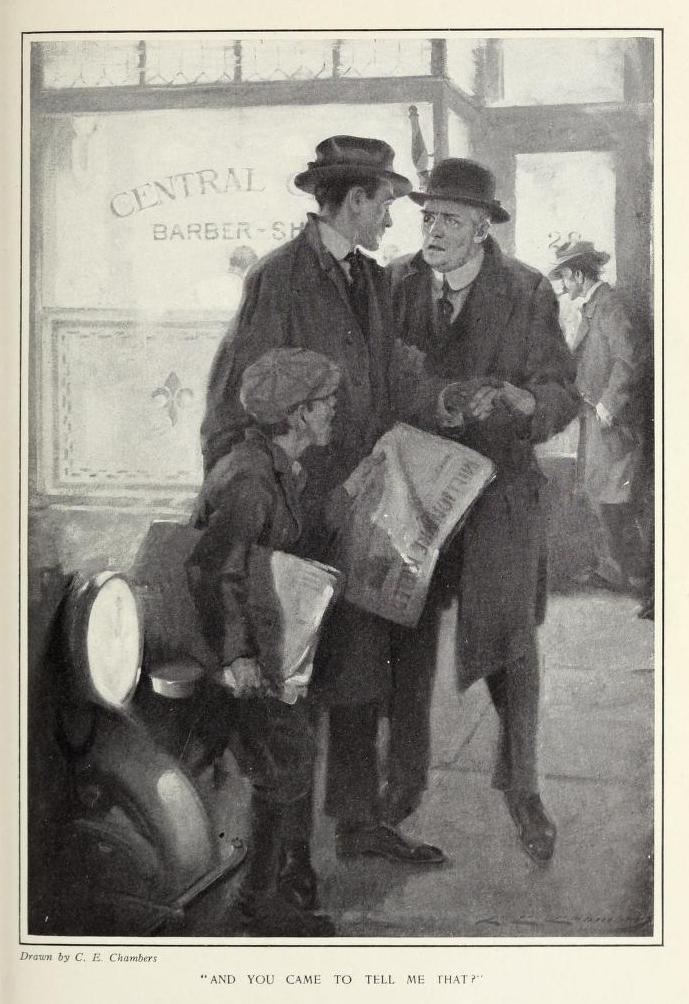
Так в чём же истинный секрет мастерства Чарлза Эдварда Чамберса (анг. Charles Edward Chambers; 1883-1941)? Почему его иллюстрации актуальны и сегодня? Мой ответ, в некоторой степени, есть повторение много раз повторённого, но учитывающий конкретику поставленных вопросов: "Моменты жизни, пропущенные через разум и сердце художника Чарлза Эдварда Чамберса, виртуозно владевшего живописным инструментарием и обладавшего сильным чувством цвета, были им искусно манифестированы зрителю в простой и ясной, наполненной человеческим содержанием художественной форме, что обусловило резонансное стереотипное восприятие и принятие его образов даже простым обывателем, далёким от салонного эстетизма".

Louquier's Third Act by Katharine Fullerton Gerould. Volume 133, 1916

The Understudy by Johnson Morton. Volume 135, 1917

Frazee by Lee Foster Hartman. Volume 135

Miss Cynthia's Rosebuch by Jennette Lee. Volume 137, 1918

The High Cost of Conscience by Beatrice Ravenel. Volume 138, 1919

Gray Socks by Charles Caldwell Dobie. Volume 138, 1919

His Fiancee by Beth Bradford Gichrist. Volume 139, 1919

Amazement by Stephen French Whitman. Volume 139, 1919

An Honest Man by Katharine Fullerton Gerould. Volume 139, 1919

Christmas Cakes by Charles Caldwell Dobie. Volume 140

The Judgment of Vulcan by Lee Foster Hartman. Volume 140

The Hidden Land by Temple Bailey. Volume 141, 1920

Glory by Grace Sartwell Mason. Volume 142, 1921

Fouled Anchor by Wilbur Daniel Steele. Volume 142, 1921

The Poppies of Wu Fang by Lee Foster Hartman. Volume 143, 1921

Ourselves When Older by Alexander Porterfield. Volume 145, 1922


So what is the true secret of Charles Edward Chambers's (1883-1941) mastery? Why are his illustrations still relevant today? My answer, to some extent, is a repetition of what has been repeated many times, but it takes into account the specifics of the questions posed: "Moments of life, passed through the mind and heart of the artist Charles Edward Chambers, a virtuoso master of the painter's tools and possessed of a strong sense of color, were skillfully manifested to the viewer in a simple and clear artistic form imbued with human content, which determined the resonant stereotypical perception and acceptance of his images even by the average person, far removed from salon aestheticism."
Иллюстрации даны по изданиям, находящимся в оцифрованном виде на сайте "Архив Интернета" (archive.org)


February 26, 2021

Чарлз Эдвард Чамберс (Charles Edward Chambers) |1914-1915 | Харперз нью мансли магэзин (Harper’s New Monthly Magazine)

Great-Grandfather's Land Scape by Mrs Henry Dudeney. Volume 132


Жизни, как известно, претит вычурность. Пейзажист и иллюстратор Джон Даунс Уайтинг в книге "Практическая иллюстрация: руководство для художников" (Practical Illustration: A Guide for Artists by John D. Whiting. Published by Harper & Brothers, 1920) заметил, что картины Чарлза Эдварда Чамберса примечательны простотой формы и полным отсутствием маньеризма — и это является одним из секретов их популярности. Добавлю, что в данном случае за кажущейся простотой форм ясно проглядывается серьёзный художественный опыт и организованный интеллект художника, позволивших ему увидеть и зафиксировать сущностное в жизненных образах близких зрителю.


The Turmoil
A Novell
by Booth Tarkington
Harper’s Magazine
Volumes 129-130
1914-1915


A May Flitting by Grace A. Croff. Volume 131, 1915

The Return of Martha by Alice Brown. Volume 131, 1915

Great-Grandfather's Land Scape by Mrs Henry Dudeney. Volume 132

North's Bargain by G.B. Lancaster. Volume 132


Life, as we know, abhors pretentiousness. Landscape painter and illustrator John Downes Whiting noted that the paintings of Charles Edward Chambers are remarkable for their simplicity of form and complete absence of mannerism — and this is one of the secrets of their popularity. I'll add that in this case, the apparent simplicity of form clearly reveals the artist's profound artistic experience and disciplined intellect, which allowed him to see and capture the essence of life's images close to the viewer.
Иллюстрации даны по изданиям, находящимся в оцифрованном виде на сайте "Архив Интернета" (archive.org)