
Ньюэлл Конверс Уайет (анг. Newell Convers Wyeth; 1882-1945) — его картины больше, чем иллюстрация - им тесно на страницах книг: всем своим эмоционально-художественным строем они вовлекают читателя-зрителя в событийность действия, пожалуй, эффектнее, чем текст.
The Courtship of Miles Standish by Henry Wadsworth Longfellow
And with pictures by N. C. WYETH
Boston and New York
HOUGHTON MIFFLIN COMPANY
1920


Rip Van Winkle by Washington Irving
Picture & Decorations by N.C.WYETH
Philadelphia
DAVID McKAY COMPANY
publishers
1921
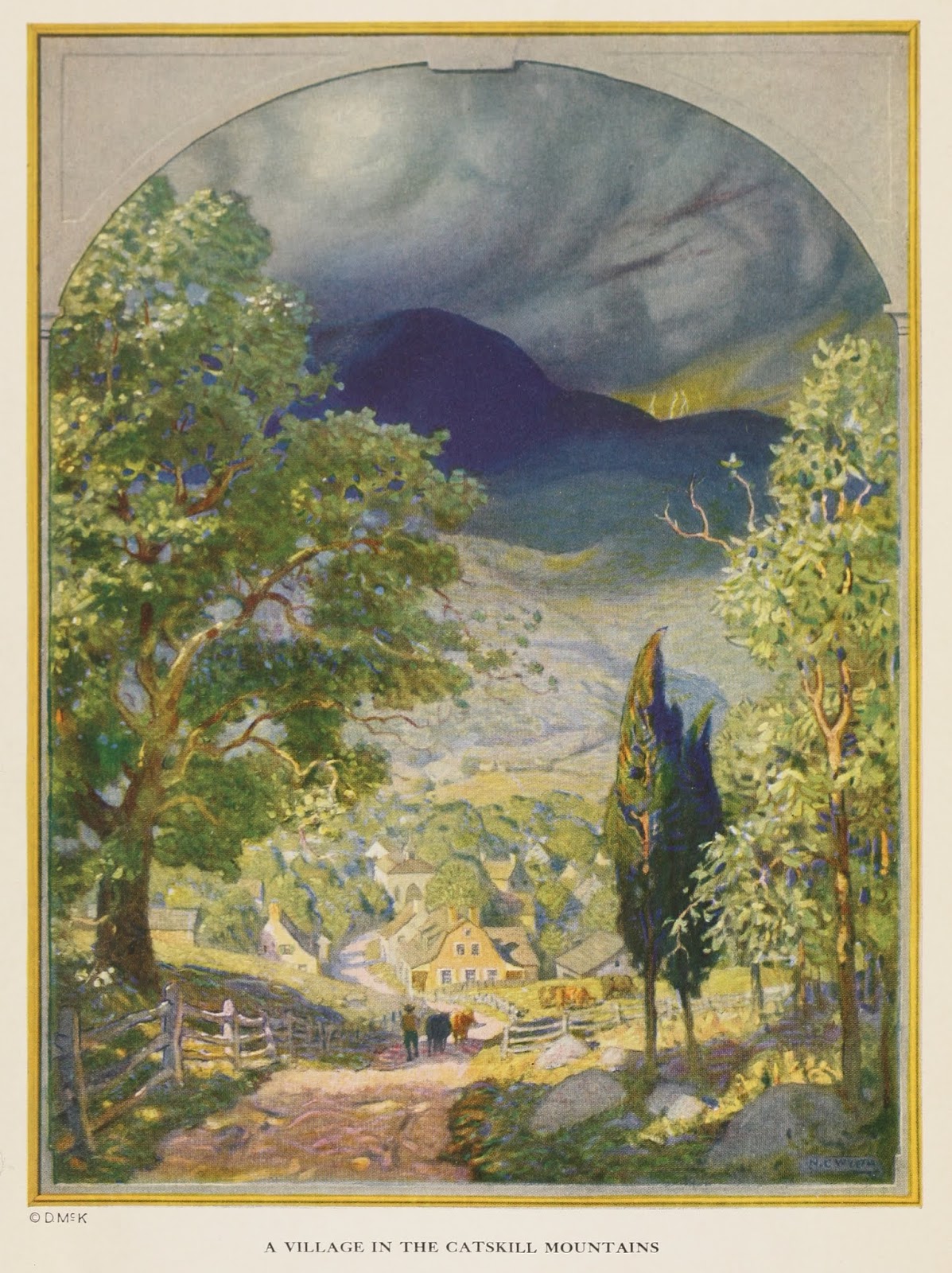


Newell Convers Wyeth (1882-1945) was one of the greatest illustrators and painters of the twentieth century. He studied under Howard Pyle between 1902 and 1904 and assimilated the teacher’s philosophy to capture natural aspects and meanings through "mental projection." The artist created 3,000 paintings and illustrated 112 books. The paintings created by the maestro are really mental: they live, sound, and are remembered; you definitely want to return to them. Dynamism and complexity of composition; excellent color and skillful distribution of light contrasting with deeply cast shadow; and something transcendental, radiating a vibrant emotionality that is immediately transmitted to the viewer, forcing him to intensely empathize with the characters in the story — this is the visual style of Newell Convers Wyeth. Wyeth himself called his philosophy of illustration a polysemantic term — "sight seen," which I would translate as the ability to look and convey what is seen to the viewer from the position of a single observer — the artist himself. That is, this is a form of presenting material in which the utmost accuracy of realities and carefully thought-out fantasies are not simply the artist's goal to convince the viewer of something but to present the event as a self-evident fact, which the viewer knew about and with which he has always agreed. Wyeth's gaze is the gaze of a child — from bottom to top, the enthusiastic gaze of a boy; it is the artist's memory of the experiences, dreams, and fantasies of childhood and youth; of the bright sun and of large trees casting long afternoon shadows; of a multi-colored, contrasting world full of movement, mysteries, and discoveries — these are our feelings awakened by the artist.